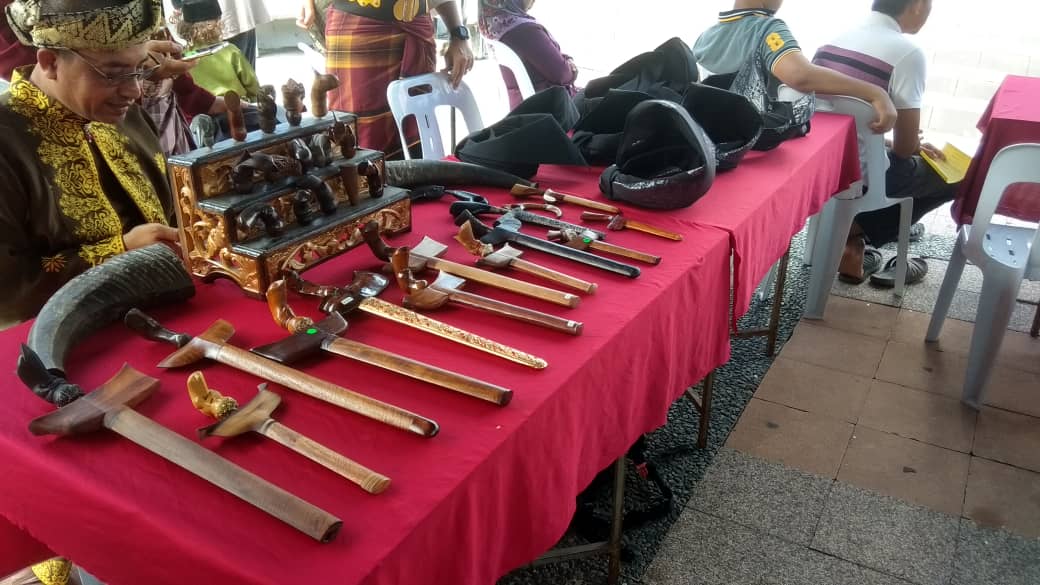
TMP has done a bit of light and easy research regarding the keris and its perception. But please bear in mind that the arguments laid down in this entry might be thinned here and there as it was conducted within limited timeframe, furthermore the research done was still inadequate. It is therefore recommended for the enthusiasts or film makers to further research and explore this topic in a greater extent so that a firmed conclusive answer can be brought forward to Malaysians.
The Malay version can be found in the Keris itu adalah 'Merong' besi? entry.
Intro: Now what is the problem?
Today, various polemics arise when the subject of keris is discussed. Keris has been stereotyped as a symbol of violence and power that portrays strength and sublimity. Keris too, is often associated with elements of supernatural impregnability, thus producing hitherto an unanswered mystical question.
The worst thing was the Malays were made to believe that the downfall of the Malay Kingdom during the 16th century was due to the absence of a Malay legendary hero and his keris, the Taming Sari. From then onwards, the people were said to be colonized by the European power for five hundred years.
Not to reinvent the wheels
Keris has been regarded by history to communicate the wrong message to Malaysians. It could be a cliché to discuss about it according to the mainstream history because it is like reinventing the wheels.
This light and simple research was conducted to investigate the true meaning and symbol of a keris based on the contrasting views of scholars on this subject for centuries.
To further support this research, the main sources reviewed included the Kedah Laws[1] (a manuscript confiscated by the British in the 19th century but recently reinstated to the Malaysia government), the Old Treaties and Documents of Malaysia (1791-1965), an age-old Malay literature entitled Hikayat Merong Mahawangsa (a version held by R. J. Wilkinson, 1889-- excerpted from SNK), alternatives and complementary views from Malay folklorists and the Holy Quran.
In addition, a few websites (informative and scholarly), namely, the:
- sejarahnagarakedah.blogspot.com,
- azlyrahman-illuminations.blogspot.com and
- kassimahmad.blogspot.com
were taken as the main online sources and they act as the basis to capturethe essence of the Malay historical reality. The writer of the former website is said to be the descendant of King Merong Mahawangsa himself, the rightful owner of Kedah throne whose his ancestors name are clearly printed in the Kedah Laws manuscript.
The latter two websites, on the other hand, were chosen because they have put so much thought and arguments with regards to the Malays’ predicament and the shaping of the Malay character according to history with regards to the keris itself.
In brief: History and function of keris according to experts
European scholar such as Richard Olaf Windstedt or famously known as R.O. Windstedt, an English orientalist who had made a systematic survey on the Malay litratures for historical purposes and laid the true foundation of a scientific approach to the writing of Malayan history, in his papers on Malay Subjects, Malay Industries (p.38 cited in Ivor H.N, Vol. XII, 1923) would state the origin of the keris is the island of Java. However, according to a renowned Malay historian, the origin of keris still remains a mystery (Dato Shahrum Yub, 2006). This is a conflicting view and would be one of the main questions that will be answered later in this entry.
In term of its functionality, the keris was originally used as a dagger-like weapon in Malay self-defense and martial arts. However, not all martial artists know how to handle a keris; only the ones who are selected by the Guru or the Grand Master would technically be taught how to use a keris. Importantly, keris must be compatible with its owner. The length of the blade should correspond to the distance between the nipples of its owner; otherwise misfortune might befall on him. A well-balanced mature blade is considered more potent. Many keris have become family heirlooms, and are thought to be more powerful by virtue of their association with previous generations (Ivor H.N, 2008)
Historical Analysis
Keris and the Malays Character: An intellectual controversy
In this modern world, there are still people who believe that the keris possesses special powers to influence the society today. The keris is considered as a tool with soul --- seen as holy as well as being a symbol of the Malays’ strength and craftsmanship.
Apart from physically and psychologically highlighted as a ‘cultural symbol of violence’ (Hishamuddin Hussein, Wikipedia, 2009), the story behind the keris has made the Malays blindly subscribed (Azly Rahman’s website, 2006) to the story that were based on myths and legends.
Hence, they suffer through the ignorance of their own history; one that contains the seeds of destruction that numb the human mind into subservience (Azly Rahman’s website, 2006)
The main figure that led to the predicament is none other than Laksamana[2] Hang Tuah, the most praised Malay hero. However, it is interesting to note the part played by the magical keris[3] in Hang Tuah's life, whereby, much of Hang Tuah achievements were partly related to the keris and, at the final count, the keris determined his whole fate (Kassim Ahmad’s website, 2005).
For example, Hang Tuah first secured it by trickery from a renowned Majapahit warrior who fought him, but whom, with the keris, he killed. Later, with the same keris, with the Sultan’s executive order, Hang Tuah killed Hang Jebat, his best friend, also after having played a trick on the latter in order to get back the weapon (which was then rightfully in Hang Jebat's possession).
J: "Thanks for killing me Tuah"... T: "My pleasure Jebat it's for the theatre and the Malay film makers"
But Hang Tuah's fate, in turn, had a significant bearing on the fate of Melaka itself. His decline also marked Melaka’s decline. At the time when he was ill, Melaka was threatened by the Portuguese and when his magic hand was withdrawn from the administration of affairs, Melaka was occupied (Kassim Ahmad’s website, 2005)
Thus, it seems that Hang Tuah had, unconsciously, by the power of the keris become a symbol of Melaka's power and greatness and the story of his end, as that of Melaka's, marked its end.
From this story, the power and the image of keris has been strongly embedded into the minds of the Malays. Deliberately, the Malays were made to believe that their fate was sealed by the keris, without it, the empire was nothing.
Media and propaganda
Therefore the Malays were said to be totally weakened and were colonised for more than five hundred years, whereas it was only Melaka who was occupied and not the whole peninsula.
The effect of this so called ‘propaganda’ lasted so long and psychologically affected the Malays in every aspect. It had become such a lingering predicament to the Malays -- unless they learn how to logically look at the history from a different perspective, the predicament would still remain.
Tun Dr. Mahathir recently mentioned in his blog that Malaysians need to re-look back to history and he actually pleading for the teaching of the ‘real’ history, “If at all history is taught it is sketchy, not really giving a clear picture of what it was like to be ruled by foreigners…Is it wrong for us to look back on the past?” (Dr Mahathir Mohamed website, 2009)
In accordance to that, must the Malays close their minds and have faith in the current ‘belief system’ (Black, 2001, p129) shaped by history especially on the keris? A symbol of subservient, rebel, violence, treachery and unexplained supernatural power as depicted in the legends of Hang Tuah.
For your information, Hikayat Hang Tuah clearly contain the elements of propaganda as it “emphasis on conflict than on cooperation in most of the situation” (Black, 2001, p134)
Never ending conflict. Never ending story.
(My dad said: " they still fighting even in the after life..." or was he just kidding me?)
Hikayat Hang Tuah: A conflicting story
The characterization of Hang Tuah, as it was portrayed by historians, on the whole, was very convincing to some people. The great event in his life was the fight with Taming Sari, the Majapahit’s warrior, the real owner of the legendary keris. As a result of which he got the magical keris that was destined to play an important part in his life.
However, the truth was that Hang Tuah and Taming Sari were from different eras, they had never met with each other as being highlighted by most historians. As mentioned by Kassim Ahmad in his review of Hikayat Hang Tuah (Kassim Ahmad’s website, 2005):
It does not matter whether or not the Hang Tuah of the fifteenth century Melaka could also be the figure in Java of the fourteenth century. The important thing is that these two historically different periods are, culturally and essentially similar. They represent the highest peaks in the Malaysian medieval eras.
Thus by saying the lost of this magical keris should mark the deterioration of his power is somewhat irrelevant. Obviously, it was not the truth to some extent; the worst thing was that the idea had been subscribed by the Malays as a whole.
Re-thinking: Historical reality as an alternative view
Historical reality is rather new to Malaysians. Promoting a new alternative view could prove a difficult task to do and not everybody would like to hear the truth.
According to the Jakarta Post (July, 2005):
Historical reality is often too bitter to swallow or too hot to stand. History is a large mirror that reflects the facts of the past, and all that have been etched into the glass of history can never be erased. If you don't like a particular historical fact, you may try to cover it up or forget it, but you can never remove it.
From a psychological point of view, normally one cannot accept new type of information because it will force them to rearrange and re-program several pieces of information it has accumulated over the years. The best way is to reject the view. It is very much anticipated that the new information from the historical reality will not be spared by the same rejection.
But, again it is important to mention that the only way to re-brand or understand the keris is by looking at the history from different perspectives as this enables us to have a refreshing story about keris.
Merong means Dragon.
Sometime the truth is stranger than fiction. In order to establish the connection between the historical reality and the keris with today’s scenario, it is best to investigate the missing link that lies in between those era.
The story goes back to the root of the oldest Malay Kingdom in the Northern state of Malaysia, Kedah. The founding father of Kedah was Merong Mahawangsa or his real name was Sultan Muzaffar Syah 1. Merong is a Siamese word for dragon (Sejarah Nagara Kedah website, 2008)
According to Hikayat Merong Mahawangsa (cited in Sejarah Nagara Kedah Website, 2008) , Sultan Muzaffar Syah 1 was a descendant of a Chinese Emperor who converted to Islam by one of Prophet Muhammad’s (Peace be upon Him) companions by the name of Saad Ibnu Abi Waqas in 650 A.D.
According to Cina Islam website, 2009 :
Menurut catatan resmi dari Dinasti Tang yang berkuasa pada 618-905 M dan berdasarkan catatan serupa dalam buku A Brief Study of the Introduction of Islam to China karya Chen Yuen, Islam pertama kali datang ke China sekitar tahun 30 H atau 651 M.
Disebutkan bahwa Islam masuk ke China melalui utusan yang dikirim oleh Khalifah Ustman bin Affan, yang memerintah selama 12 tahun atau pada periode 23-35 H / 644-656 M. Sementara menurut catatan Lui Tschih, penulis Muslim China pada abad ke 18 dalam karyanya Chee Chea Sheehuzoo (Perihal Kehidupan Nabi), Islam dibawa ke China oleh rombongan yang dipimpin Saad bin Abi Waqqas.
Sebagian catatan lagi menyebutkan, Islam pertama kali datang ke China dibawa oleh panglima besar Islam, Saad bin Abi Waqqas, bersama sahabat lainnya pada tahun 616M. Catatan tersebut menyebutkan bahwa Saad bin Abi Waqqas dan tiga sahabat lainnya datang ke China dari Abyssinia atau yang sekarang dikenal dengan Etiopia. [kalau dari Afrika mesti jalan laut la yang paling sesuai!]
According to another source, this was where some of Saad Abi Waqas companions landed in Semenanjung and carry on with the dakwah mission while Saad Abi Waqas proceed to meet the emperor of China.
this part was further discussed in the following entry:
- Siapa kata JAWI Melayu punya?
Dragon @ Merong: Where does it come from?
As we all know, Chinese emperors used dragon as a symbol. If we ponder into it deeply, how did the Chinese know how to draw this creature if they had not seen it in the first place?
This again goes back to a verse in the Quran that talked about the King Iskandar Zulkarnain. In this study, he would not be referred to as Alexander the Great from Cyprus as mentioned in many books (historyofmacedonia.org., 2008)
Come, let us refer to the verse from Al-Quran below (Surah Al Kahf: 90-96):
[90] Until, when he [Zul-qarnain] came to the rising of the sun, he found it rising on a people for whom We had provided no covering protection against the sun…
[96] ‘Bring me blocks of iron.’ At length, when he had filled up the space between the two steep mountain sides, he said, ‘Blow (with your bellows)’ then, when he had made it (red) as fire, he said: ‘Bring me, that I may pour over it, molten lead.’
The story above was about King Iskandar Zulkarnain who was in his journey to spread the words of God had reached the land of the rising sun (Asia-China). He then helped the local people to fight the barbaric tribe dubbed as Gogs and Magogs where he finally locked them behind the iron wall that was created in between two steep mountains.
It was said the creature that had helped him blew out the fire was a dragon. (Logically, no men can blow enough fire to melt down iron and brass to create the massive iron bar in the given time, as mentioned in the story above). From there on, the image of dragon has been used as a symbol of power not only in China but in other Asian countries.
this part was discussed in the following entries:
- Metallurgy Melayu?
- Daabatul-Ardhi - itu Malaikat?
- Naga di Masjid Demak?
Ukiran naga di Masjid Demak. Pengaruh siapa?
Some historians claimed that the Malays were originally from China, particularly from Yunnan. In some aspects, Hikayat Merong Mahawangsa actually had proven them right as Merong Mahawangsa himself used dragon as a title and is believed to carry a symbol with him in a form of a dragon that was the wavy keris.
There is also a similarity in term of culture between those two kingdoms, although it might not be a strong evidence but it was worth to be pondered upon.
As mentioned in the Kedah Laws (Mariyam Salim, 2005, p.50),
“Demikian lagi bertilam beralas kuning, batang bantal kuning atau sapu tangan kuning, maka itu hukumnya dicarikkan oleh segala yang melihat itu…”
In a simple word, it says that the subject of the Sultan are probihited to wear yellow. It goes the same to the Han Dynasty whereby the royal court began to use yellow as the official colour because it symbolizes the gold. The emperor’s subjects were prohibited to wear yellow clothing (Divineshows.com, 2009).
Maharaja China Islam Sai Tee Sung dari Dinasti Tang
The Ming Dynasty Emperor also used yellow as the royal costume full of dragon emblem (Emperors of the Ming Dynasty, Wikipedia, 2009)
Laksamana Cheng Ho @ Hj Mahmud Syam. (Brother in law of Rama Tibodi Parameswara Sultan Rijaluddin ibni Mohammad Johan Syah Al Adil)
According to the Kedah Laws, the protocol and the monarch system used by the Malay Sultans today actually originated from the Merong Mahawangsa Siamese Court’s protocol, this would include the keris.
The prove of the linkage between the Siamese (Malay) King and King Iskandar Zulkarnain customs can be found in the Kedah Laws manuscript. In the text, that was originally written in Jawi-Arabic script it was said that:
Sedutan Teks Undang-Undang Kedah, 2005, MS 43-49
:
Daripada Hijrah Nabi Sallallahu alaihi wasalam, 1199H, iaitu tahun Ha, pada 28hb Safar, hari Isnin, bahawa pada ketika itu maka titah Yang DiPertuan Yang Maha Mulia [kalau hari ini merujuk kepada DYMM AGONG] ke atas jemala Datuk Bendahara menyuruh muafakat dengan segala pegawai mengaturkan segala adat pada fasal menyatakan aduran () hamba Allah taala...
Fasal pada menyatakan faedah raja-raja di dalam negeri. Maka tiap-tiap raja itu mengadakan ia pekerjaan dan suruh-suruhan seperti tandil dan penghulu pada khalifah, mata-mata dan bendahara pada majlis balai itu, dan pada majlis Istana Raja Iskandar Zulkarnain [rujuk Surah Al-Kahfi 83-85 dan seterusnya] kepada Paduka Seri Sultan yang di atas kerajaan sekarang maka adalah ia iaitu () akan martabat raja pada hal perintahkan segala adat tuannya atas segala menteri itu.
Maka dihimpunkan hukum itu diatas sembilan hukum.
Fasal yang pertama pada menyatakan adat majlis segala raja-raja dan adat pakaian sekalian raja-raja dan larangan segala raja-raja kepada pakai oleh sekalian rakyat...
Demikian lagi memakai hulu keris emas seperti hardis dan barang sebungkal, itu pun tiada boleh dipakai orang lain melainkan dengan nama kurnia anugerah itu maka dapat. Jikalau orang memakai dia, maka hukumnya dirampas. Adapun memberi anak cucunya hulu keris emas itu melainkan bendahara juga, maka tiadalah orang lain dapat memakai dia.
...Itulah sifat segala raja-raja pada zaman dahulu kala turun temurun datang sekarang. Itulah kanun namanya.
The above script stated that the protocol of King Iskandar Zulkarnain’s court would have been passed over and be used by the next king for generations to come without any amendment.

Sebuah mural pada perabot dari Ayuthia yang di simpan di Muzium di Bangkok. "King Narai himself is said to have been under Iranian cultural influence in terms of his daily food and dress and his preferred architectural styles", M. Ismail Marcinkowski, Phd, "SAFINE-YE SOLAYMANI"

this part was discussed in the following entry:
The evidence of the use of King Iskandar Zulkarnain’s protocol can be seen in the Malay King’s installation ceremony i.e. when the King raises and kisses the government’s keris as a symbol of sovereignty as stated in the Presentation of Government Keris protocol during the New King’s Installation ceremony:
The Datuk Penghulu Istiadat then takes the pedestal tray containing the Government Keris and accompanies the Datuk Paduka Maharaja Lela to approach His Majesty. In front of the throne, the Datuk Paduka Maharaja Lela bows and receives the tray containing the Government Keris from the Datuk Penghulu Istiadat and steps up the throne until the third step, kneels and presents the Government Keris. His Majesty, the Yang di-Pertuan Agong receives the Keris, draws and kisses it. The Datuk Paduka Maharaja Lela steps down… [Malaysian Monarch website, 2008].
Therefore, the missing link and the connection between the Siamese or Malay King and the King Iskandar Zulkarnain royal regalia is already there but had never been fully researched until today. The main question remains -- why must the Malay Royals use folklore as the base of their history?(Malaysian monarchy website, 2008)
this part was discussed in the following entry:
- Berkeris Melayu menjunjung adat siapa?
These findings are new to Malaysians and the truth is Malaysia’s history actually does not start with the Melaka Empire in 1404 AD, but it originated from Kedah who was ruled by Merong Mahawangsa. The Kedah Law that was written in 222 Hijrah or 827 A.D. is the hard evidence of these new findings. Malaysians have yet to know of these new discoveries.
For the scholars who referred to Melaka as the foundation for studying keris, they would never get the answer that they wanted as all of the existing resources they have are looping and pointing at the same point -- that is Hang Tuah and Taming Sari Keris will forever remain as an unsolved mystery to them.
Totemism and metaphor: Keris -- a symbol in a form of a dragon?
Another scholar by the name of Frazer, in his Totemism and Exogamy (1910; repr. 1968 cited in Questia website, 2008) defined that “a totem is an object but it is normally a plan or animal, more rarely a class of inanimate natural objects, very rarely a class of artificial objects.”
Thus, according to the above definitions, the keris can also be regarded as a totemic icon to the Malays. In fact, some of the keris worshippers have realized the fact that keris has taken its shape from a dragon.
According to a comment from a researcher (cited in Asiafinest website, 2008):
Lastly the Malay ethnicity is also continuing the naga [dragon] snake cult. For an example, the Malay ethnicity has a family ancestral sword called a ‘Keris’ it is a wavy blade that is shaped to look much like a snake’s body. The handle of the sword is even designed to look like a serpent’s head which we call a ‘naga motif.’ The keris is a symbol of our ancestors, it is said to be the reincarnation of our ancestors and true Malays carry their family keris with them at all times and treat it as though it were a part of their body with its own life.
According to Frazer in his Totemism and Exogamy (1910, repr. 1968 cited in Questia website, 2008):
Totem was defined as an object, usually an animal or plant (or all animals or plants of that species), that is revered by members of a particular social group because of a mystical or ritual relationship that exists with that group. The totem may be regarded as a group symbol and as a protector of the members of the group. The symbol of the totem may be tattooed on the body, engraved on weapons, pictured in masks, carved on totem poles’.
Therefore, it is logical to say that the keris actually symbolized the dragon in a form of a weapon that had been inherited since the reign of King Iskandar Zulkarnain, the Chinese Emperor, Merong Mahawangsa and lastly to the Malay Kings. It is fair enough to say that the keris is actually a totemic icon, and well regarded as a symbol of power, protector and unity to all his (the King) subject.
To further strengthen the fact, the symbol of dragon could also be found engraved on two of Prophet Muhammad's (Peace be upon Him) swords, namely Al Ma’thur and Al Rusub (Ahmad Lutfi, 2007) that are kept in Topkapi Museum in Istanbul, Turkey.

this part was discussed in the following entry:
- Ukiran Naga Pedang Ottoman
Quick observation and data gathering
The observation and data gathering were done during the Traditional Weapons Exhibition, Mysteries and Mystical Belief at the National Museum, Kuala Lumpur in December 2008.
To make things clear or to get some hints, the observation and interviews were carried out in four sessions on three different groups:
- To the high authority;the politicians and the museum director
- The keris blacksmiths; experts
- The laymen.
The high authority person interviewed were then Minister of Unity, Culture, Arts and Heritage, and the Director General of the National Museum. Thank you very much for their kind input!
The main reason why all the key figures such as the Minister and the Museum’s Director General were picked was because they are the key people in-charge in determining the policies of the museum and the museum’s best interest. Through such policies and activities, the function of history and how it is being communicated to the masses is best determined.
A clear example of this was the title of the exhibition itself that focus on mysteries mystical belief of traditional weapon. That somehow gave some ideas of what the exhibition was all about and the kind of messages they were trying to convey to the masses. The title of the exhibition itself was emphasizing and pointing toward the mystical belief of the Malaysians!
The keris makers and the experts were vital in this research as they are to explain the true meaning of the keris in terms of its make; while the visitors were the ones whose interests and views on the keris were important to identify keris in the eye of the new generations of Malaysia.
For keris as a symbol that belongs to Malaysians, a question about keris and its role was asked to the then Minister of Unity, Culture and Heritage of Malaysia. The responses were overwhelming but they were again based on the existing history that was being taught in school:
The exhibition on traditional weapon especially keris, is related to our history. It is important to know that keris has the elements of art which is very close to the Malays. The usage of keris is determined by the intention of the holder. If he intends to use it for killing then it is violence, but if he uses it for defense then that is a different story. Keris is not only a symbol for the Malays but it is one of the components of culture in Malaysia. It can be a tourist attraction too. It can be beneficial to those who are involved in tourism. It is owned by everybody. It must be recognized that it can bring a lot of benefit to many, especially to the country.
The same question was posed to Director General of National Museum, and he said:
We don’t have any problem for keris to be a symbol of unity for Malaysians. As long as they can understand that the keris belongs to everybody and not limited to a certain race only. Basically, it all depends on how we think that is based on the perception and expectation. If it is for the context of heritage and people really understand the concept of heritage than we as Malaysians have to accept it unconditionally without putting any barrier between races. Again, it all depends on their perceptions. On behalf of the museum, we don’t have any problem to highlight keris as a symbol of unity as long as people can accept it as a heritage for all.
It is clear that the main things that came in mind of the twos were the perceptions on the keris usage. They were not talking about the arts of the keris. Not to forget that the kind intention of the two should not be taken cynically. Both of them really wanted the keris to be accepted by ALL MALAYSIANS!
But how would they possibly do that if to refer to the existing belief system? Hopefully the findings of this research will help the government and to give a definite answer and solution to the question.
What says the Keris Blacksmith and the experts?
According to the blacksmith, the keris is actually a special weapon. A man normally carries two types of keris -- one to show his rank and his social status and the other, to be used in fighting or to defend himself:
A peasant or common soldier carries one type of keris that is cheap and normally short in length and lightweight to compare to the high rank warriors who own the nicely crafted high quality keris. This particular keris is only bestowed by the Sultan to men he likes and was made of special irons and brass by selected blacksmiths. Some of the elements can only be found from the Java Island, the reason was because that place has many volcanoes.
He then further commented and justified the conflict between the scholars mentioned earlier in this study:
That is maybe why many English orientalists would relate keris to Java. The concept is just the same like Batik manufacturing, where the best Batik comes from Terengganu and people would appreciate Terengganu’s batik for its craftsmanship quality. The same perception goes to keris. People appreciate the Javanese keris because of its craftsmanship -- and why do you think Hang Tuah’s keris (the Taming Sari) was a Javanese keris? Therefore, the keris can be found all over the Malay archipelago but the best one comes from Java.
His logic actually justified (and most probably) answered the conflict between the scholars mentioned earlier in this study.
When asked whether he believed in Hang Tuah’s story, he said:
I’m not going to undermine the historians, but I personally do not believe in the story. If Hang Tuah ever exists, where is his tomb? Can we actually rely on his keris’s superpower to withstand the coming of the Portuguese? Furthermore, according to the keris protocol, Hang Tuah cannot use Taming Sari as his keris because it was not meant for him. The measurement is only for Taming Sari, that, if he also exists…
The blacksmith actually gave an alternative view that was inclined with the historical reality and supported that the theory of duel between Hang Tuah and Taming Sari was fabricated. This was based on his understanding that every keris has its own measurement and could not be simply transferred to other people.
His claimed was further supported by a text by Ivor H.N Evans (2008) saying that every keris has its own measurement:
The true keris was personally requested by the owner and was made accordingly to the owner’s measurement. A keris cannot be passed over to other people as the measurement of the other person differs from its original owner. A lucky keris to the owner might not be lucky onto the next owner.
*Therefore, in the case of Hang Tuah, he actually cannot use Taming Sari keris (if it does exist) as the measurement is different. If Hang Tuah is a true warrior, he should know this by then.
When asked if the true keris blacksmith ever exists in this modern world, he said:
To make a real keris is not easy. Ancient blacksmiths used to spend three months or even sometimes more than a year just to finish a keris. Therefore it is hard to find a real keris nowadays, unless it is passed down to generations. Nowadays, people do not really care about the authenticity of the keris anymore because they hardly have vast knowledge about it. They (the customers) just walk in and make an order based on sample that we provided on the shelf, and we will deliver within a week. We do it for commercial and we use modern machinery. If a keris can be completed and delivered in less than a week, you would know that it is not the real one. The symbol has now narrowed down to the general term of weapon called keris -- no more on the art of making and identifying the owner like in ancient time. So, if the real blacksmith ever exists in this modern world, yes -- but they would not do it for commercial.
He then continued with some advice:
As a Malay you should keep one in your house. It is not for its mystical purpose but as a symbol of your Malay-ness. It doesn’t matter if it is not bestowed upon by the Sultan and it doesn’t matter too if it is not authentic because the most important thing is just to keep one for yourself and for your future generation to know that they are Malays. This is the only symbol that truly represents the Malays. The problem with the people now is that they tend to use the keris to arouse the moral of the Malays and at the same time intimidating other races (mostly politicians). That gives a bad image to the keris itself. Honestly, a sword is more dangerous than a keris. Unlike the keris, a fine sword like the Japanese Katana or the British Saber which can actually kill more people in a single blow. They have been used in many wars. They give pride to makers and the owners. Same goes to the Malays. We should have pride for the keris -- it is not necessary for us to not be apologetic to some extent. The perception of the people must be changed…but then again, it goes back to what had been printed and highlighted in the history book. The Malays also used sword in battlefields.
Finally when asked about whether the keris is a weapon or a symbol, he stated:
A keris is a weapon and at the same time a symbol to the Malays. Ancient men used it as symbol of status, some sort like a protocol. Our history did not highlight the later part and the media does not play its role to further educate the minds of the people. The media or the film makers only show the violence and treachery part of the keris. Who is to blame here?
What say the museum visitors?
Unfortunately, the outcomes of some of the interviews were very much anticipated. As keris was automatically related to the Melaka's history and had been pre-set in the mind of Malaysians, basically, all referred back to the Melaka’s Sultanate history and were evolving around the same theory and concept.
Basically none of them have related the keris to its totemic being. One of the best responses that nearly reached out to free the keris from its stereotype form would come from a visitor who happened to do some research about the keris:
A sample cited from a comment from Azly Rahman website, 2006:
I once read an article by a keris historian. According to the historian, the keris' origin is not based in one localization, but rather it is unique to the whole of Southeast Asia. The keris represents the union of the male and the female. The intricately designed blade represents the male while the equally intricate and beautiful scabbard with all its ornaments represents the female. The blade is never removed from its scabbard, in accordance with its symbology. Instead the keris was often contemplated upon for its deep underlying philosophical beauty.
Definitely the historian who wrote about the keris had subscribed to the same concept of weapon metaphor, the male and female thing.
For some of the non-Malays interviewed, keris was a very sensitive subject to be discussed. Most of them chose to evade from answering question with regards to keris:
This is very sensitive subject. But as far as I know the keris is symbol of power because not many people used keris that time and to me it is just a weapon -- that’s it.
Regarding the question on their perceptions on the keris, many responses would relate keris to its violence form but in a cynical way:
I know a story from a Malay that a special keris can actually kill a man just by thrusting his enemy’s footprint. That is quite awesome! But I don’t think that magic comes from the keris; it must be the bearer himself with special kind of black magic or something, like the voodoo. So from where does the power come from? The keris or the man?
The problem is how the non-Malay can accept keris as a symbol of power when the Malays themselves cannot really explain where the power came from. The King can use sword as symbol of power and sovereignty but why must he use the keris?
Somehow or rather, this is where the Merong Mahawangsa’s connection logically comes into place.
------------------------------------
TMP's views.
The main problem was quickly detected; if one does not understand the character of a keris, he or she would have a standard answer for all the questions. They would not be able to relate the keris to any symbol other than the perceptions that had been pre-set to them.
Let us consider these two scenarios: when Tunku Abdul Rahman declared the date of Merdeka would be 31 August 1957, he unsheathed, kissed and thrusted the keris towards the sky. This act was previously accepted as a symbol of the success of a united struggle by the people of Malaya at that time (Democratic Action Party Website, 2009)
And when the then UMNO Youth Chief Hishammuddin Hussein Onn did the same act during UMNO’s General Assembly in 2008, his keris-waving became highly controversial. However, in the recent March 2009 UMNO’s General Assembly, he had kept the keris for himself and did not unsheathe it like before. The question is -- why was that?
If we ponder deeply into the above scenario, both acts were based on keris as a symbol of weapon of struggle which was seen offensive. The unity only comes into picture in 1957 because of the act that was done using the keris and not because of the keris itself. On the latter act, the keris had unintentionally divided Malaysians into unnecessary racial tensions – again, this is all because of perception.
Based on the observation carried out and data gathered, one most obvious dilemma or predicament identified was the negative perception and mistrust of the Malaysians towards the keris itself. The problem lies not with the keris’ high quality craftsmanship or artistic value but on the people’s perceptions.
As mentioned before, the public opinions were rather cliché and were very much predicted. This had been anticipated due to the much overly-heard and seen propaganda in the Malay history that revolved only around the history of Melaka and Hang Tuah. It is hopeful that a new belief system could further help educate and change people’s mindset on this issue.
The findings of this study also show that the ‘belief system’ has successfully influenced most Malaysians --- even the Minister and the keris blacksmiths were not spared. Even though the keris blacksmiths would actually have had the expert’s knowledge on the true secret of the keris, they too can be influenced or manipulated by the same historical propaganda.
The story of Hikayat Hang Tuah and his keris for instance, also relies on “authority figures and spokespersons rather than the empirical validation to establish its truth, conclusion or impression.”(Black, 2001, p.134)
Here lies the real challenge of this research as it was carried out to decipher or interpret the true and symbolic meaning of the keris using the open-minded non-dogmatic approach. Black (2001, p.129) stated that:
The non-dogmatist journalist or researcher will face a constant struggle to remain open-minded by evaluating information on its own merits; is governed by self-actualizing forces rather than irrational inner forces; discriminates between and among messages and sources and has tentative reliance on authority figures; recognizes and deals with contradictions, incomplete pictures of reality, and the interrelation of past, present, and future; and moves comfortably and rationally among levels of abstractions (fact, inference, and value judgment).
In this view, the objectives of carrying out this research could be seen as a new means of interpreting history – an alternative means to making history more relevant.
However, it does not mean that this research denies the current historical evidences or materials --- it is just an investigation that would pave better way in understanding the Malay history, breaking the belief system and taking the mass out of their own complacent cocoon about their own history and origins; thus breaking away from the media and propaganda.
Black (2001, p.129) further reiterated by saying that:
If people lack time, opportunity, and inclination to become fully acquainted with one another and with their environment, it is only natural for them to act as Rokeach's (1954, 1960, 1964) dogmatic, closed-minded media consumers-prompted and fulfilled by media whose stock in trade is production of such public opinion-molding propaganda.
Thus, we cannot blame the mass for their ‘divided’ perceptions and impressions on the research findings. As mentioned earlier, this paper offers a fresher alternative on the subject matter to help free the Malaysians from the ‘dogmatic claws’ and close-mindedness.
Based on the historical analysis provided earlier in the literature review, it is clear that Malaysians are not aware that keris has a very meaningful symbol if historical reality is put back into place.
The misconception and perception of it is as merely a weapon must be changed to a meaningful and strong symbol of unity. It actually happened once in history in 1957, but then the feeling disappeared through thin air.
It is sad to say that Keris has been unjustly dictated to speak the language of the bone and skulls (intimidating or warning sign). It has been misunderstood mostly by all Malaysians. If Malaysians go back to reality, and relate the keris to its true form that is a dragon for example in an aspect of totemism, and by looking history at a difference perspective, then things will start to make sense.
But in doing so the history has to be rewritten and reinterpreted. One of the hardest things to do is to accept the fact that the Malay Peninsula was under Siamese rule and the Siamese were actually 'Malay' Muslims and the Malay Sultans were using the Siamese customs in their regalia.
But can the historians accept this kind of new findings? This proves to be a challenging task.
However, it all depends on the society to value keris. Black (2001, p.133) again reiterated:
“…creative communication accepts pluralism and displays expectations that its receivers should conduct further investigations of its observations, allegations, and conclusions, propaganda does not appear to do so.”
Whether or not the keris stands as a weapon or a mere symbol, it all depends on the individual’s knowledge on its history and his interests on the subject matter. In the Malaysian social setting where its education system, in a way, had been pre-determined by a certain dogmatic and much publicized belief system, political propaganda seemed to have taken much benefit out of this issue.
On the other hand, a research that is open-minded, global, logical and non-dogmatic in nature may prove to unveil its way out of the current dilemma faced by the Malaysians today. Deciphering history in the aforesaid manner would help Malaysians solve their own historical puzzle.
With the totemic dragon at the helm, symbolizing the power of the King and the people, the spirit and moral of the people can be brought back to live. With the new findings, the government has to consider re-educating the Malaysians based on the historical reality -- relating the history of keris and its relevance to the history of Merong Mahawangsa, the Siamese-Ayuthian Empire, the Chinese Emperor and most importantly, what has been prescribed in the Holy Quran about Iskandar Zulkarnain and Prophet Muhammad’s (peace be upon Him) companion, Saad Abi Waqas’ mission to China. All of these have proven that the keris is not merely a weapon but a symbol of racial unity in the Malay Archipelago.
It is strongly suggested that the evidence that comes with the Kedah Law manuscript must be further investigated as it might change the landscape of the Malay Monarch that is currently based on unexplained myth and legend. (Malay Annal compiled and edited by Tun Seri Lanang in 1612 : Demang Lebar Daun dan Sang Nila Utama - White Bull - Undersea Kingdom?)
The keris needs to be respected as it should be is by revealing its true nature. By affiliating it to a dragon or merong as a symbol of totemism or metaphor, its role as a symbol of power will be much easily understood and accepted by most Malaysians.
END.
Tajuk ini menarik tetapi agak sensitif. Oleh itu pertimbangan waras pembaca amatlah dihargai. Semoga ada manafaat daripadanya...
* home made movie (bukan KRU) in the making...