"Education aims at independence of judgement. Propaganda offers ready-made opinion for the unthinking herd."
THEMALAYPRESS - FIKIR DENGAN KRITIS | TERUS MELANGKAH LEBIH JAUH.

Assalamu'alaikum wbt dan salam sejahtera. Terima kasih kepada para pembaca yang masih setia mengikuti blog ini!
~ MOHAB (Blog layout versi 1 September 2014 - 17.07.2014 - 19 Ramadhan 1435)

Selasa, Februari 21, 2012

Azan Maghrib di Chiang Kong - Wilayah Paling Utara Thailand

0 comments
Chiang Khong (เชียงของ) is a town in Chiang Rai Province, Northern Thailand. It is mainly visited as a stop-off point en-route to the ferry crossing to Laos.

Suasana Maghrib di Chiang Kong - hening sunyi.
Azan maghrib yang dilaungkan oleh seorang anggota JWJ memecah keheningan senja di Chiang Kong di Wilayah Paling Utara Thailand.
Perkhidmatan bot untuk menyeberang sempadan Thai-Laos hanya beroperasi dari jam 6:00am ke 6:00pm.
(photo HAB)

Understand
Chiang Khong is the Thai counterpart to the Lao border town of Huay Xai, just across the Mekong. Chiang Khong is a small, sleepy town with one main road and no night life. It has a Friday market, a lot of temples, a craft village with a busy market and a temple. The best time to visit is from October to January, or on the April 18 Giant Catfish Festival when baby giant catfish are taken to the Mekong river.

Where is Chiang Kong?

Get in
From Huay Xai in Laos by a short ferry trip (10,000 Kip) across the Mekong (6am to 6pm). Thai Immigration here seems to lack both computers and the annoying cameras now installed in Bangkok's airport and, consequently, is extremely quick. However, arriving by this overland route means that you will only be given a tourist visa valid for fourteen days, compared with the 30 days you would get flying into Bangkok. The ferry is at the northern end of Chiang Khong: if you want to move on without stopping in the city, take a tuktuk to the bus station in town for 30 baht per person, or you can walk 3km.

Sumber Inggeris: Pakcik Wiki.
Read full post »

Isnin, November 21, 2011

Gong Perdamaian Dunia - World Peace Gong in Laos

0 comments
I couldn't sleep. So I packed up my gear and went a walk by myself looking for interesting subject at 2:00 am in the morning.

Patuxai Monument
"It's already late, no entry sir," says the guard
"Just gimme 10 minutes ... please ... big dogs you have there..."

Patuxai - literally meaning Victory Gate or Gate of Triumph, formerly the Anousavary or Anosavari Monument known by the French as Monument Aux Morts) is a war monument in the centre of Vientiane, Laos, which was built between 1957 and 1968. Patuxai is dedicated to those who fought in the struggle for independence from France. In romanising the name from the Laotian language, it is variously transliterated as Patuxai, Patuxay, Patousai and Patusai. It is also given the name of Patuxai Arch or the Asian version of Arc de Triomphe of Vientiane as it has general resemblance to the Arc de Triomphe in Paris; however, it is typically Laotian in design, decorated with many Buddhist mythological figurines such as of kinnari (half-female, half-bird figures) - Uncle Wiki

Finally, I got the Peace Gong.
(Dua orang jaga Gong tidur dalam kelambu...nyamuk tak hengat. Pakkai jaga tu ada, kalau dak mau gak gi ketuk gong tu ... baru jaga satu dunia pakat bangun. )

Gong Perdamaian Dunia - World Peace Gong (History)
Vientiane Laos , 8th June
2:36 am

Where is Vientiane?


 From a distance, at night, the street and the monument reminds me slightly of Paris too ... but of course with extremely peace.

What a Crazy Night!

HAB
Laos, 2011


Read full post »

Selasa, November 15, 2011

STORMBRINGER - EYE ON THE SKY

0 comments


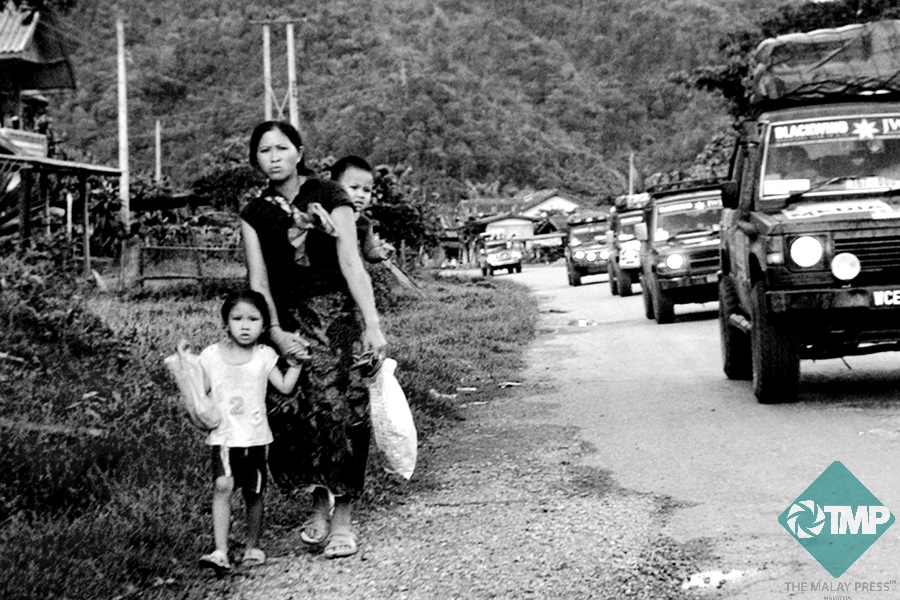
This shot was taken just before the convoy moving up to Luang Prabang.


The storm was heading right toward us. Hold your ground!

"Becareful of the 'I' ..." - I'd like to attest that your statement was somewhat not wrong my friend.

HAB
Laos
2011

WHAT IS A STORMBRINGER ?


Stormbringer is the ninth studio album by Deep Purple, released in November 1974


(Blackmore/Coverdale)


Read full post »

Jumaat, November 11, 2011

Angkorcalypse Now

0 comments
An Apocalypse (Greek: ἀποκάλυψις apokálypsis; "lifting of the veil" or "revelation") is a disclosure of something hidden from the majority of mankind in an era dominated by falsehood and misconception.


Bayon, the state temple at Angkor Thom, [it is believed by the west that] Jayavarman VII’s (1181-c.1218) walled city.
Who actually built it?

Prasat Angkor
"Unlike most Angkorian temples, Angkor Wat is oriented to the west; scholars are divided as to the significance of this. Further evidence for this view is provided by the bas-reliefs, which proceed in a counter-clockwise direction—prasavya in Hindu terminology—as this is the reverse of the normal order. Rituals take place in reverse order during Brahminic funeral services. The temple is admired for the grandeur and harmony of the architecture, its extensive bas-reliefs, and for the numerous devatas (guardian spirits) adorning its walls." - Uncle Wiki

French postcard about Angkor Wat in 1911.
Henri Mouhot popularised the temple in the west in the mid 19th-century


The 1000 year old ruins of Angkor Wat, are just a couple miles to the north the small town of Siem Reap, Cambodia.
Can you count how many 'Kampongs' are there in Cambodia?

"Nobody sent me. I sent myself here.." a quote.

HAB
Angkor
Kingdom of Cambodia, 2011


Apocalypse Now, A Film History & the Sacrificial Water Buffalo


Bayon Temple, Cambodia
Photos by Simon Glassock


This article was written by Simon Glassock

Francis Ford Coppola’s Apocalypse Now is one of the most famous of all Hollywood films. It is a transposition of Joseph Conrad’s novel, Heart of Darkness, from the jungles of 19th century Belgian Congo to the jungles of Indochina during the Vietnam War. Released in 1979, just four years after the fall of Saigon, it has become one of the defining artistic representations of that traumatic conflict. Like the book, the film traces a river journey up-country in search of a European so far removed from his own civilisation that he has ‘gone native’ and, by reason of this deracination, mad.

In Coppola’s version a renegade Special Forces officer, Colonel Kurtz, has raised an army from the Montagnard (or Moi, in Vietnamese) tribes of the Central Highlands of Vietnam and is leading them in an independent war against the Viet Cong from his base at an abandoned Cambodian temple. Kurtz has allowed himself to be deified by his followers and is assuming the power of life and death over all who come within his reach. With rumour about Kurtz and his methods swirling wildly, even among the North Vietnamese, American military command in Saigon decides that he has become an unstable liability and Captain Willard is sent on a clandestine mission to terminate Kurtz' command, 'with extreme prejudice’.

Filming on location began in March 1976; a mere two months later Typhoon Olga struck, destroying the set and other equipment with an estimated loss of $1.3 million.

Marlon Brando’s portrayal of the insane Kurtz was itself more than a little eccentric. He arrived on location for his three week shoot grossly overweight, demanding to be filmed almost entirely in shadow and insisting on an ad lib script since he declined to learn any lines, let alone read the novel upon which the film was based. In an interview 30 years later Coppola reported that Brando’s script was worked up from recorded conversations he had had with the actor, who would then learn his lines by listening to recordings through an earpiece. Coppola may also have resorted to reading Conrad’s novel out loud to his star, though in the same interview he declared that Brando did finally read the book, if only the night before his filming started.

The other lead actor, Martin Sheen, was battling alcoholism and suffered a near-fatal heart attack during filming which necessitated his brother being flown in to act as a double. Quantities of drugs and alcohol were ingested by the cast and crew and the temple complex was at one stage decorated, for want of a more appropriate word, with real corpses.

Several scenes from the film have arguably slipped into the public consciousness and helped define the war itself: to the rising crescendo of Wagner's Ride of the Valkyries Lieutenant Colonel Kilgore's helicopters attack a Vietnamese village so that Lance Johnson can surf 'Charlie’s break'; Kilgore strides around the beach, inviolate under fire and intoning the line that has probably accompanied a thousand charred barbecue sausages:

I love the smell of napalm in the morning.

And all the while, a rock and roll soundtrack punctuates the episodes of death and destruction surrounding Willard on his journey upriver. Some of the most arresting images, however, come in the climactic closing scenes of the film which feature a graphic and disturbing sequence in which the sacrificial slaughter of a water buffalo is interleaved with Kurtz’s own execution.

Although these scenes appear to be highly stylised, the sacrifice was not improvised but part of a ceremony held by the Ifugao people, who had been recruited to play the Montagnards, and drawn to Coppola’s attention by his wife. The final act begins with Kurtz, silhouetted in the doorway to his temple sanctum, handing a buffalo to his followers. Illuminated only by lightning, massed ranks of candles and the guttering flames of torches, the buffalo is led to a carved stake, around which etiolated figures are dancing. To the accompaniment of a rapid, monotone drumming, men with shields and spears surround the motionless beast and shuffle rhythmically back and forth, enacting in symbolic slow-motion their killing thrusts. This puppetry is brutally swept aside as four parang-wielding men in loin-cloths step forward and hack down hard and fast and again and again into the animal’s body. Just as Kurtz is cut down by Willard, the buffalo is all but decapitated at the shoulders, its hind-quarters almost severed at the haunches.

As Coppola acknowledged, it was fortuitous that this sacred, and therefore blameless, violence took place at precisely the moment when he was seeking a way in which to portray Kurtz’s own death:

I was really desperately looking for a way to end the film, as the original script had an ending more appropriate for a war film in the style of A Bridge Too Far. So I decided, after much thought and conversation, to have Martin end by assassinating the great king (Kurtz), and utilise the fact that the Ifagao (sic) people were going to sacrifice their water buffalo on our last day of shooting. 
Perhaps too, the film was by now touched by a certain madness which demanded a blood offering to expiate its own sins and fully complete the process of creation. Whatever the reason, Coppola deliberately associated the sacrifice with Kurtz’s death, underlining the symmetry of their fates by showing Kurtz gifting the buffalo to his followers just as he acquiesces in his own destruction and delivers himself up to Willard's blade. At an artistic level the scene provides as powerful and logical a conclusion as exists in the visual arts, no matter how disturbing the content may be to some in the audience.

But, whether Coppola was aware of it, it was also entirely consistent to include an animal sacrifice that took place in the Philippines in a film set in Vietnam and Cambodia. More than a quarter of a century earlier Norman Lewis had travelled in Indo-China to report on the Viet Minh war against the French re-occupation of Vietnam after the Second World War. In A Dragon Apparent Lewis recorded his impressions of the Montagnard tribes of Vietnam and recalled witnessing a sacrifice at a Jarai village near Pleiku in which a buffalo was tied to a stake, hamstrung by men with coupe-coupes, the Jarai half-knife, half-axe, and then speared to death. Lewis also visited the Khmer ruins around Siem Reap in Cambodia where he may have seen the reliefs showing scenes of daily life which run around Bayon, the state temple at Ankgor Thom, Jayavarman VII’s (1181-c.1218) walled city.

Among these can be found a panel featuring a group of men with raised spears surrounding a buffalo tied to a stake. The depiction is realised with enormous skill. The taut figures, gathering to deliver their blows, threaten to escape the confines of the stone from which they are carved and the buffalo stares at the viewer, demanding participation in the unfolding drama. The sculptor holds life and death in delicate balance, suspending the moment but unable to change the outcome. The sacrifice is as real and imminent today as it was when the frieze was carved 800 years ago.

Although Buddhism became the Khmer state religion under Jayavarman VII the ritual portrayed at Bayon evidently predated the temple by a considerable time. No matter that the Khmer capital had been located at Angkor since the ninth century, the Moi regarded Angkor Thom as the product of “strangers recently arrived in the country”.

(Before the Vietnam War, the population of the Central Highlands, estimated at between 3 and 3.5 million, was almost exclusively Degar @ Montagnard as known by the French. Today, the population is approximately 4 million, of whom about 1 million are Degars. The 30 or so Degar tribes in the Central Highlands comprise more than six different ethnic groups who speak languages drawn primarily from the Malayo-Polynesian, Tai, and Mon–Khmer language families. The main tribes, in order of population, are the Jarai, Rhade, Bahnar, Koho, Mnong, and Stieng.)

Lewis knew that the Jarai are related to, among others, the Igorot of Luzon in the northern Philippines but he may not have known that the sacrifice he witnessed was also a religious-cultural practice shared with tribes across south Asia, ranging from India through Indo-China to Indonesia, and including the Igorot, of which the Ifugao are a constituent. Water buffalo are of particular significance to these peoples. Lewis claimed that the buffalo was considered by the Moi to be more than an animal and hardly less than a human and it may be that they act as a substitute for human sacrifice. Not only are they routinely offered to appease ancestral spirits and to safeguard public constructions  (Lewis’ buffalo was killed to place a school building under the protection of tribal spirits, and, perhaps, the depiction on the Bayon frieze was of a sacrifice for Jayavarman’s temple) but, more pertinent here, they also assume special importance in funerary rites where they function as the symbolic carrier of the deceased’s soul to the afterlife.

Probably unwittingly, Coppola’s finale was thus thoroughly grounded in ethnographic reality to the extent that the buffalo sacrifice in his film is an almost exact copy of the Bayon panel. But without artistic intuition this alone, even if intentional, would be mere mechanics. Coppola's transformation of violence into art was achieved by making Kurtz complicit in the sacrificial nature of his own death by allowing Willard to perform an act that had been sanctioned and legitimised by an authority greater than either man's.

Crucially, Kurtz acknowledged this by giving his Montagnard followers a water-buffalo, the symbolic means by which to celebrate his death and convey his soul to the afterlife.

end.

* just for your reading pleasure ... well just read it over and over until you comprehend.
Read full post »

Sabtu, Oktober 15, 2011

Sesepi senja Sungai Kra.

0 comments
Sungai Kra di Tanah Genting Kra - Sepinya menyimpan seribu rahsia. 

Mengalir diperbatasan sempadan Semenanjung Tanah Melayu yang berada didalam wilayah Thailand.

Perjanjian telah dibuat diantara Khalifah Syarif Syah Dynasti Ayuthia dengan Raja Thailand Sukhotai. Bahawasanya Thai berjanji tidak menyerang wilayah Melayu (Melayu adalah gelaran yang diberikan oleh Raja Thai seterusnya British/Perancis kepada Raja Siam Islam) melewati perbatasan ini. 

Maka ditanamlah sebaris pokok Rhu demi memperingati perjanjian itu dan diperbuat batu tanda pula oleh British dan Perancis menyatakan dengan jelas wilayah Melayu itu sampai di sungai ini.

Malangnya pada tahun-tahun berikutnya Thai memungkiri janji lalu menyerang Siam (Melayu) melewati perbatasan ini maka terjadilah peristiwa berdarah yang dikenali sebagai Perang Musuh Bisik 1821.

Pada tahun 1909 diperbuat pula perjanjian Bangkok. Maka semakin sempitlah Semenanjung Tanah Melayu seperti yang terlakar pada peta hari ini.

Tuntutan wilayah Melayu itu sedang diusahakan oleh pihak yang berkenaan, tetapi beritanya masih sepi, sesepi senja Sungai Kra.

~hanya mampu menyusuri tepian~

Read full post »

Selasa, Oktober 11, 2011

The Streets of the Seven Countries

0 comments

This is a tribute to Jejak Warisan Jawi II expedition.
An expedition participated by a group of youngs Malaysian explorers that travelled to the seven countries of IndoChina. And the countries include Malaysia, Thailand, Cambodia, Vietnam, Laos, Luang Prabang, China and Burma. It took them 22 days of heaven and hell, night and day, bone cracking journey through the hellish traffic of Cambodia, dusty roads of Laos, beaches of Viet Nam, hilly-holish roads of Luang Prabang, magnificent tunnels of China, that all together stretched up to approximately 10,000 km of snakey overland-journey dated back in May 2011 before safely making the home-run in June 2011.


All still photos were taken using Rollei 35

This is only the beginning...


Read full post »

Jumaat, Julai 22, 2011

The Road to Luang Prabang

1 comments
The road to Luang Prabang.
The ancient city of Lao Old Kingdom. 
What is the secret that was sealed in the Lao royal library?
Perhaps, this was where the story begin.

Some intresting points to ponder:
Khun Lo was the eldest of the sons of Khun Borom who had seven sons and the first of the Lao kings. The royal families of Laos trace their lineage to him. He founded the city of Luang Prabang. Khun Borom Rachathirath is the legendary progenitor of the Tai-speaking peoples, considered by the Lao and others to be the father of their race. [This include the Sukhotai - this is mine]. Linguistic analysis indicates that the division of the early Tai speakers into the language groups that gave rise to modern Thai.

Nota:
Inilah bangsa majusi penyembah api dan berhala dari gunung, yang turun menjajah hampir keseluruhan benua Siam sampai ke pangkal leher semenanjung Tanah Melayu.

Temubual terdahulu (hampir 3 tahun sudah):

"Depa mai dari Luang Prabang, Boten." - TNL Kassim.

"Kalau kita tak pertahankan semenanjung ni dahulu, abih dah semua jadi Buddha." - Anai-anai @ Nai Long Mazlan Majid.


Binaan cantik Wat Buddha di Luang Prabang. 
Nak masuk kena bayar, kalau dak, nampak pak guard 4 ekor tercongok kat depan tu?

Sini ada sorang Sami boleh cakap Melayu.
"Dari Malaysia ? Sekeping gambar USD 10," - kata sami.


Melayu jadi Buddha? Semua altar terahsia, Mala-yu, Lost Tribe pun abih hilang entah kemana. Pakai la ihram kaler oren, untung-untung dapat USD10 posing sekeping gambar.

Bulan ni nak makan apa?


Wassalam

Herman Abdullah
Luang Prabang, Laos
09.06.2011

Read full post »

Isnin, Julai 04, 2011

Viet Nam - Cruising under the Stars

0 comments
Don't worry sir. 
We understand the international prohibition sign : no entry above pretty well sir.


Read full post »

Ahad, Jun 26, 2011

Jendela Tachileik

0 comments

Seorang anak gadis sedang memerhati diruang jendela yang menghadap masjid di Tachileik, Burma.
(Rollei 35, Fuji Neopan 400 B/W)

Located on the Myanmar - Thai border in the eastern Shan State, is being upgraded as a gateway to the heart of the Golden Triangle. The Friendship Bridge across the small Mae Sai stream links Tachileik with the northern Thai border town of Mae Sai. The area is currently being developed for tourism and cross-border trade with Laos, Thailand and China. One can fly direct from Yangon to Tachileik in an hour. There is a ferry-landing site at Wanpon port on the Mekong River at the Myanmar - Laos border, 29 km from Tachileik. The port also handles goods shipments to and from Thailand and China. Work is under way to develop to town as a exchange center for trading goods. A short flight to Tachileik will be the beginning of a tour of the infamous Golden Triangle. Tachileik sits on the banks of the Mekong River across from Mai Sai in Thailand. It is a cross border town. A one-and-half hour away from Tachileik we arrive at Mai Pong, where we can enjoy a boat tour of Mekong River.
Read full post »

Isnin, Jun 20, 2011

HMONG PEOPLE AND BATIK

0 comments


Walk the talk
Luang Prabang-Boten (LAOS)

For the Hmong people, they live high up in the mountain. When they talk, a single word I don't understand. But I noticed the traits of shyness and batik decoration creativity in them - Jejak Warisan Batik I would say.

Herman Abdullah
Read full post »

ANGKOR CAMBODIA RAINY SEASON

0 comments


RAINY DAY @ KOMPLEKS ANGKOR
CAMBODIA

Wet soaking sweat I was.
Read full post »

Sabtu, Jun 04, 2011

FROM CAMBODIA WITH HOPE

1 comments

From Cambodia With Hope
(Lokasi sebuah masjid lama di Kemboja)

Salam hormat daripada TMP buat para pembaca yang dihormati semua. Dan saya baru punya masa untuk buka blog di Ho Chin Min City, Vietnam. Baru sejam check in hotel.

Sebenarnya program JWJ 2 very tight. Untuk pengetahuan pembaca sambutan masyarakat Islam-Melayu disana sungguh menggalakkan.

Anyway, sekeping gambar 'orang kita' dari kejauhan buat pelepas rindu untuk semua.


Wassalam.
Herman Abdullah.


Read full post »

Rabu, April 27, 2011

JWJ II Trailer

0 comments


JWJ 2 Misi Malaysia Tour a video by Fourth Screen.
Read full post »

Khamis, April 14, 2011

JWJ II Malaysia Check Point Meeting

1 comments


Malaysia, we are preparing for JWJ Malaysia Tour 7 States 22-24 April 2011
13/04/2011 Semenanjung
Read full post »

Isnin, Disember 13, 2010

Catatan JWJ2 - NO PIG!

1 comments
Persiapan JWJ2 nampaknya semakin rancak. Dalam perjumpaan 'check point' yang diadakan baru-baru ini, banyak juga perkara yang telah disentuh walaupun tidak secara detail tapi memberi input yang bermanafaat.
Read full post »

Selasa, November 30, 2010

Catatan JWJ2 - Passport Malaysia

0 comments
Manakala hendak ke luar negara mestilah seseorang itu mempunyai passport. Tanda pengenalan rakyat Malaysia dibawah kerajaan yang dinaungi oleh Duli Yang DiPertuan Agong Malaysia.

Maka setakat yang aku tahu, passport antarabangsa itu punyai dua macam. Satu yang 2 tahun dan satu yang 5 tahun. Yang 2 tahun itu sebenarnya memberikan kelonggaran untuk keluar negara hanya selama 1 tahun 6 bulan dan bayarannya hanya seratus ringgit Malaysia sahaja, begitulah juga yang 5 tahun hanya punyai tempoh 4 tahun 6 bulan dan bayarannya hanya tiga ratus ringgit Malaysia sahaja.

Kerajaan Malaysia tidak membenarkan rakyatnya keluar negara jika tempoh passport berbaki 6 bulan dari tarikh sah sesuatu passport itu. Ini ada tertulis didalam passport.
Read full post »

Ahad, November 21, 2010

Catatan JWJ 2

2 comments
Kehangatan Jejak Warisan Jawi 2 sudah mulai terasa bila mana surat Kapten China sudah masuk 'mailbox'. Gerak kerja pun bermula. Masing-masing yang terlibat telah pun diberi tugas untuk dilaksanakan. Maka aku pun terlibat sama ler. Sorang pun tak boleh relax nampaknya sampai ler tahun depan. Inilah yang dinamakan 'marathon', belum pun habis lelah JWJ 1, baton pun sampai. Memang pancit kalau nak ikut ni, tapi semangat tak boleh luntur. Tak rock ler ye dak, Amy Search pun boleh rocking sampai la...
Read full post »
 

Copyright © T H E . M A L A Y . P R E S S Design by Free CSS Templates | Blogger Theme by BTDesigner | Powered by Blogger